

MES vs ERP: Understanding the Key Differences and Benefits for Modern Manufacturers
- Introduction
- Do We Need MES if We Already Have an ERP System?
- What is ERP in Manufacturing?
- What is MES in Manufacturing?
- Why Manufacturers Need MES Over ERP
- Benefits of Integrating MES and ERP
- The Future of Manufacturing: MES, ERP & Industry 4.0
- Why Choose Us for Your MES & Digital Transformation Partner
- Conclusion
Introduction
Manufacturing organizations are under increasing pressure to improve productivity, reduce operational costs, maintain consistent product quality, and respond quickly to changing customer demands. As digital transformation accelerates across the manufacturing sector, companies are investing in technologies that provide greater visibility, control, and efficiency throughout their operations. Among the most critical technologies driving this transformation are Manufacturing Execution Systems (MES) and Enterprise Resource Planning (ERP) systems.
Despite widespread adoption of ERP software, many manufacturers still struggle with challenges such as unplanned downtime, limited production visibility, quality issues, and manual data collection. This often leads decision-makers to ask an important question:
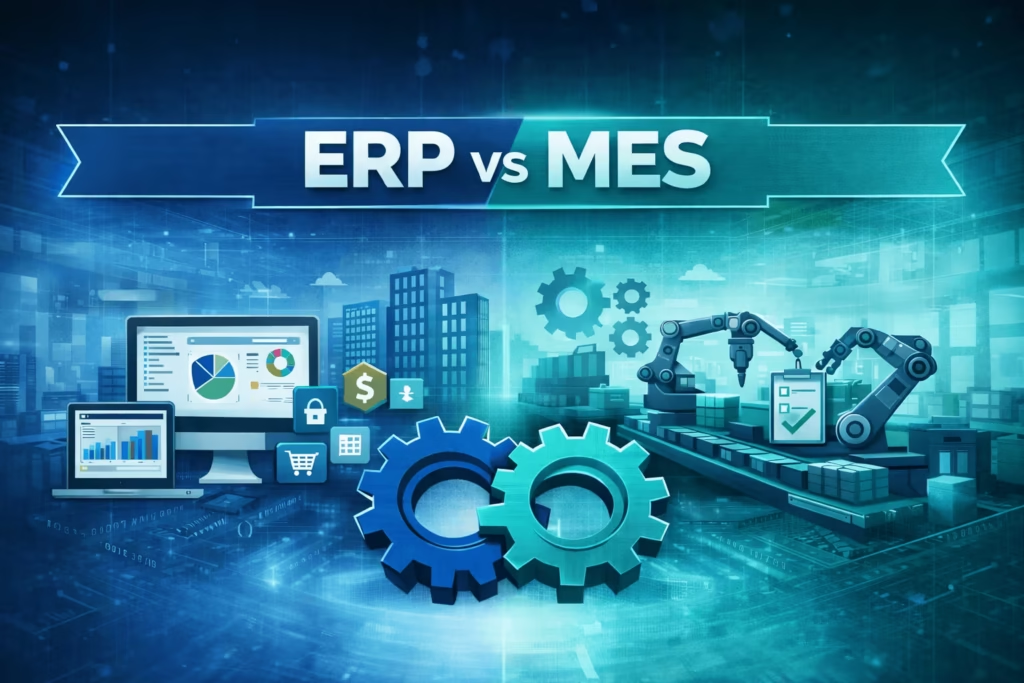
Do we need MES if we already have an ERP system?
The answer lies in understanding the distinct roles these systems play. While ERP software helps manufacturers plan and manage business resources, MES software focuses on monitoring, controlling, and optimizing production activities on the shop floor. Understanding the difference between MES and ERP is essential for manufacturers seeking to improve operational performance and build a strong foundation for Industry 4.0 initiatives.
In this guide, we explore the key differences between MES and ERP, explain their benefits, and demonstrate why integrating both systems can significantly improve manufacturing efficiency, quality, traceability, and profitability.
What is ERP in Manufacturing?
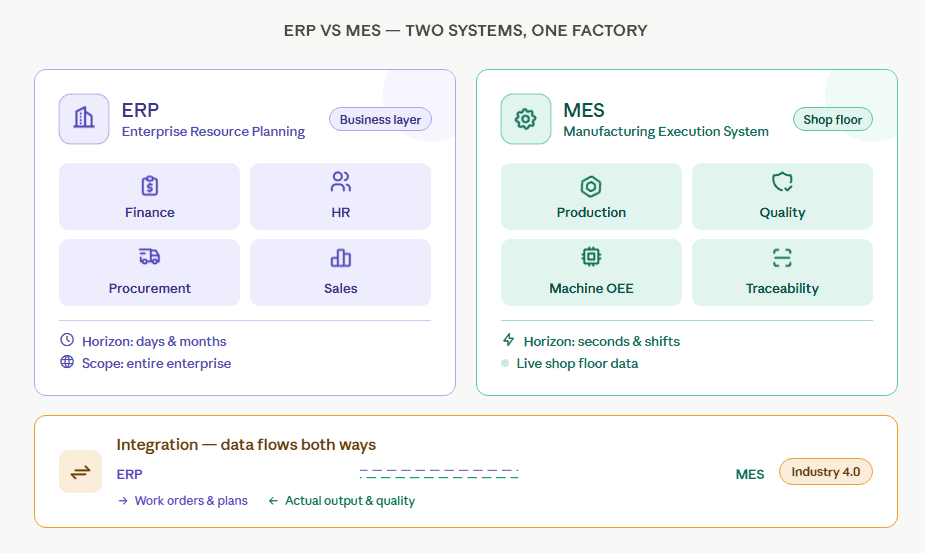
Enterprise Resource Planning (ERP) software is designed to manage and integrate core business processes across an organization. In manufacturing environments, ERP systems help companies manage functions such as inventory, procurement, sales, finance, production planning, supply chain operations, and customer orders. ERP acts as a centralized platform that provides management with a comprehensive view of business operations and resource utilization.
When a customer places an order, the ERP system determines material requirements, schedules production, manages inventory availability, and tracks financial transactions associated with that order. ERP software plays a critical role in ensuring that business resources are allocated efficiently and that organizational processes remain aligned with strategic objectives.
However, ERP systems primarily focus on planning and administration rather than real-time production execution. While ERP can tell managers what should be produced and when production should occur, it often lacks visibility into what is actually happening on the shop floor at any given moment. This limitation creates a gap between planning and execution that many manufacturers struggle to overcome.
What is MES in Manufacturing?
A Manufacturing Execution System (MES) is a specialized software solution designed to manage, monitor, and optimize manufacturing operations in real time. MES operates directly on the shop floor, collecting data from machines, production lines, operators, sensors, and quality systems to provide complete visibility into manufacturing performance.
Unlike ERP software, which focuses on business management, MES software focuses on production execution. It tracks work orders, monitors machine performance, captures quality data, manages production workflows, records downtime events, and provides real-time production analytics. By connecting people, processes, and equipment, MES enables manufacturers to make faster and more informed operational decisions.
One of the primary advantages of MES software is its ability to provide real-time visibility into production activities. Production managers can immediately identify bottlenecks, monitor machine utilization, track production progress, and respond to quality issues before they impact delivery schedules or customer satisfaction. This capability makes MES an essential component of modern smart manufacturing and Industry 4.0 strategies.
MES vs ERP: Understanding the Core Difference
The most fundamental difference between MES and ERP lies in their purpose. ERP focuses on planning and managing business operations, while MES focuses on executing and controlling manufacturing processes. ERP answers questions such as what products need to be manufactured, what materials are required, and when production should take place. MES answers questions such as what is currently being produced, how efficiently equipment is operating, whether quality standards are being met, and where production issues are occurring. Consider a manufacturer producing industrial equipment. The ERP system may schedule production for 5,000 units and allocate the necessary materials and resources. However, the MES system monitors whether those units are being produced according to schedule, identifies machine downtime, tracks operator performance, and records quality inspection results. This distinction highlights why MES and ERP are complementary technologies rather than competing solutions.
MES vs ERP: Real-Time Visibility and Production Control
One of the biggest differences between MES and ERP is the level of operational visibility they provide. ERP systems typically rely on periodic updates and transactional data, making them valuable for strategic planning but less effective for real-time decision-making. MES software continuously collects production data directly from the shop floor, providing instant visibility into manufacturing operations. With MES, production managers can monitor machine status, work order progress, production output, quality metrics, and downtime events as they occur. This real-time insight enables manufacturers to identify and resolve issues before they escalate into larger operational problems. ERP systems, while essential for business planning, simply do not provide this level of manufacturing visibility.
MES vs ERP: Quality Management and Traceability
Quality control has become increasingly important as manufacturers face higher customer expectations and stricter regulatory requirements. ERP systems can store quality-related records and support compliance documentation, but they are not designed to manage quality processes in real time. MES software integrates quality management directly into production workflows. It captures inspection results, tracks non-conformances, records process parameters, and provides complete product traceability. Manufacturers can trace materials, machines, operators, and production batches throughout the entire manufacturing process. This level of visibility is particularly important for industries such as automotive, pharmaceuticals, food processing, and aerospace, where compliance and traceability are critical business requirements.
Why ERP Alone Is No Longer Enough
Many manufacturers initially invest in ERP software expecting complete operational visibility. While ERP remains essential for managing business processes, modern manufacturing requires deeper insight into production performance. As organizations pursue digital transformation initiatives, they need real-time access to production data, machine performance metrics, quality information, and operational analytics. Without MES software, manufacturers often rely on spreadsheets, manual reporting, and disconnected systems to manage production activities. These methods create delays in decision-making, increase the risk of errors, and limit opportunities for continuous improvement. MES fills this gap by transforming production data into actionable intelligence that supports operational excellence.
Benefits of Integrating MES and ERP
Manufacturers that integrate MES and ERP systems gain significant advantages in productivity, quality, and profitability. Real-time production visibility enables managers to make proactive decisions that reduce downtime and improve resource utilization. Quality management becomes more effective because inspection data and production information are captured automatically and made available throughout the organization.
Integrated MES and ERP systems also improve traceability, making it easier to meet regulatory requirements and manage recalls when necessary. Production schedules become more accurate because planning decisions are based on real-time manufacturing data rather than assumptions or outdated information. As a result, manufacturers can improve delivery performance, reduce operating costs, and increase customer satisfaction.
The Future of Manufacturing: MES, ERP, and Industry 4.0
As Industry 4.0 continues to reshape manufacturing, MES software is becoming increasingly important. Technologies such as Artificial Intelligence, Industrial IoT, predictive analytics, and digital twins rely on real-time production data to deliver value. MES serves as the foundation that connects machines, operators, processes, and business systems within a smart manufacturing environment.
ERP systems remain essential for managing enterprise resources and strategic planning, but MES provides the operational intelligence needed to support advanced manufacturing initiatives. Together, these technologies create a powerful platform for continuous improvement and digital transformation.
Why Choose Us as Your MES and Digital Transformation Partner?
Selecting and implementing MES software requires more than technical expertise. It requires a deep understanding of manufacturing operations, quality management, production workflows, and business objectives. Our team helps manufacturers evaluate MES solutions, develop implementation strategies, integrate MES with existing ERP systems, and build roadmaps for digital transformation.
Whether your goal is improving production visibility, reducing downtime, enhancing quality control, or implementing Industry 4.0 initiatives, we provide practical solutions that deliver measurable business outcomes. Our focus is not simply deploying software but helping manufacturers achieve sustainable operational excellence.
Conclusion
The discussion around MES vs ERP is not about choosing one system over the other. ERP and MES serve different purposes and deliver maximum value when used together. ERP manages business planning and enterprise resources, while MES provides real-time visibility and control over manufacturing operations.
Manufacturers seeking greater productivity, improved quality, enhanced traceability, and stronger digital transformation outcomes should view MES and ERP as complementary technologies. By integrating both systems, organizations can create a connected, data-driven manufacturing environment capable of meeting the demands of today’s competitive market.
Ready to Improve Manufacturing Performance?
Schedule a free MES assessment with our experts and discover how MES software can transform your production operations, improve quality management, and accelerate your digital transformation journey.
FAQ's
What is the main difference between MES and ERP?
ERP manages business planning and resources, while MES manages and monitors real-time manufacturing operations.
Can MES replace ERP?
No, MES and ERP serve different functions and are most effective when integrated.
How does MES improve manufacturing efficiency?
MES improves efficiency by providing real-time visibility into production, downtime, and machine performance.
Does ERP provide real-time shop-floor visibility?
No, ERP focuses on planning and transactional data, while MES provides real-time shop-floor visibility.
Is MES suitable for small and mid-sized manufacturers?
Yes, MES helps manufacturers of all sizes improve efficiency, quality, and production visibility.
What are the signs that a company needs MES software?
Frequent downtime, manual reporting, poor traceability, and limited production visibility indicate a need for MES.
How does MES support digital transformation?
MES digitizes manufacturing processes and provides real-time data required for smart manufacturing initiatives.